🗣️ Google Ads Drops Your Language Setting This Month and Keeps Returning It: The Criterion That Reads Live but Targets Nothing, and What to Segment On Instead
Late September: campaign-level language targeting leaves Search. The criterion still returns in the API, and decides nothing. What to segment on instead.
🚀 THE EXECUTIVE SUMMARY
The Definition: In late September Google Ads removes the campaign-level language targeting setting from Search and AI Max for Search campaigns, and from the Search Network portion of Performance Max. Search ads "will automatically match based on the language of your ads". In the API the criterion does not disappear: these language criteria "will still be returned when querying even though they are not used for targeting".
The Core Insight: The dimension you report on and the signal that decides delivery are about to swap places. campaign_criterion.language.language_constant stays selectable, filterable and populated, and stops deciding anything on Search. What replaces it, the language of your ad and your landing page, has no field in the Google Ads API: no segments.language, no language attribute on ad_group_ad or a text asset. Your language column will read in October exactly as it read in August, while describing nothing.
What changes, and what keeps reading
On Search and AI Max for Search, the setting is gone. Delivery is decided by the language of the creative and the landing page, matched against what Google believes the reader understands, defined broadly in the footnote: "User language(s) can be any of the languages the user set, regularly interacted with, or searched in." Google will also "prioritize ads that match the user's search term language", where today a query with no clear language signal, a brand name say, favours the reader's preferred language.
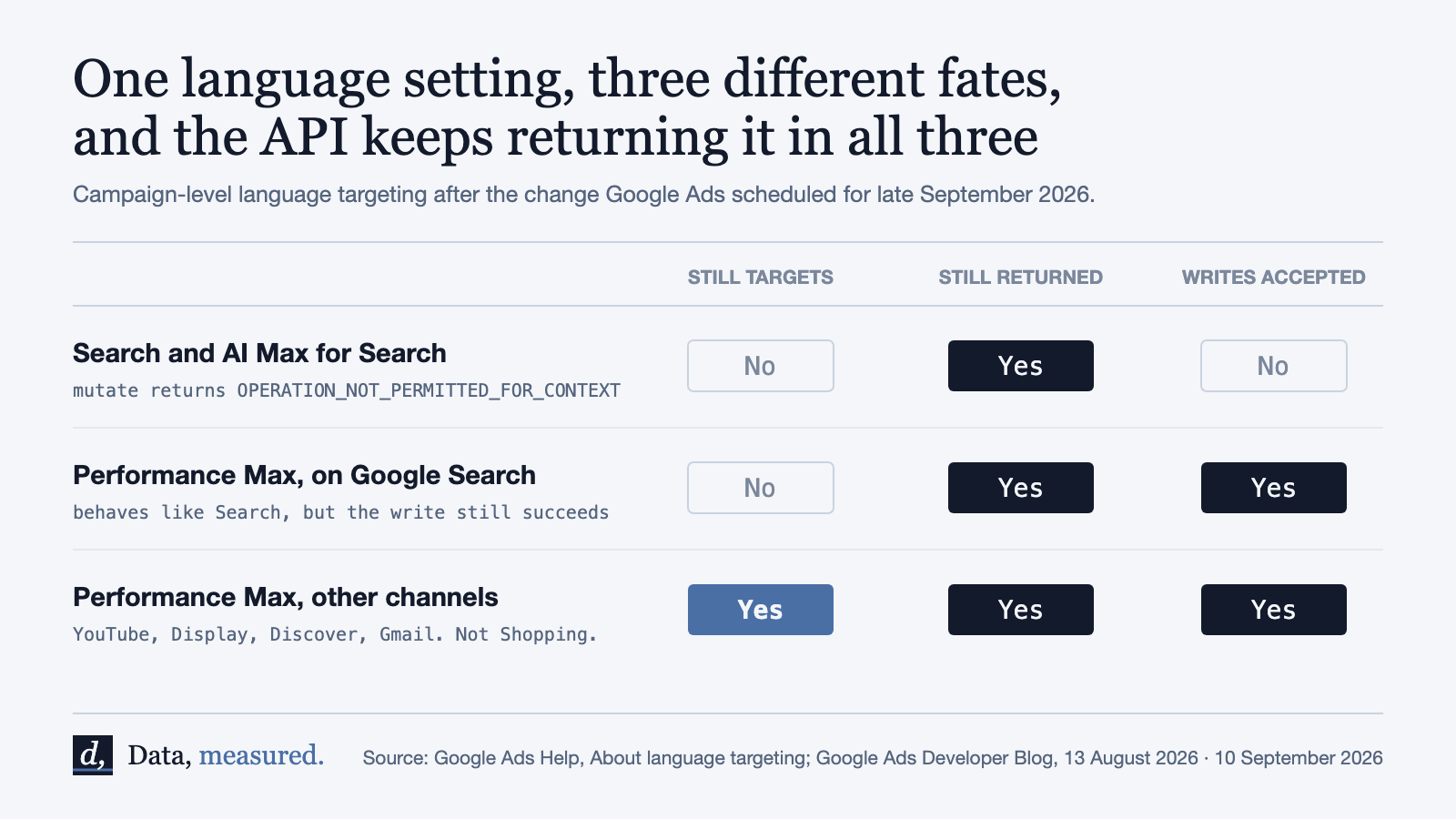
On Performance Max the setting splits by channel. It no longer applies on the Google Search Network, it still applies on YouTube, Display, Discover and Gmail, and Shopping ads inside Performance Max are not governed by it. One row in your settings export, three truth values, resolved by where the impression landed.
The write path breaks asymmetrically. Per the Google Ads Developer Blog, a mutate that adds or updates CampaignCriterion.language on a Search campaign "will result in a ContextError.OPERATION_NOT_PERMITTED_FOR_CONTEXT error". On Performance Max there is no error, because language may still be used elsewhere. A shared routine that sets campaign languages fails loudly on half your account and succeeds quietly on the rest.
The compliance angle: a control you could evidence, replaced by an inference
Language targeting was a declared setting. You could export it and file it, and regulated advertisers did, because it cheaply showed a campaign for a licensed product pointing at the market where the licence applies. From late September that stops being true on Search, and the export still shows the language. This is the worst shape a compliance artefact can take: a control that documents itself as live after it stopped working.
The replacement signal sits with Google, not you. "Regularly interacted with, or searched in" is a behavioural inference about a person, drawn from their query history and account settings. You cannot select it, join it, or produce it. What you control is the ad and the landing page, and Google says so: ensure creatives and landing pages "are clearly structured in the intended languages".
That raises the stakes on the creative, because the ad's language is also a policy surface. The unsupported language policy disallows "ad or destination content in an unsupported targeting language", so the signal that now decides who sees your ad is the one that can get it disapproved.
Four places to put the language dimension
Nothing in Google Ads hands you a language column now. You build one or go without.
| Where it lives | Queryable | What it tells you after late September | Cost |
|---|---|---|---|
| The campaign language criterion | Yes, unchanged | What you once asked for. Nothing about delivery. | None, the trap |
| Campaign naming or a label | Yes, via campaign.name | Stated intent, with no drift detection | A naming rule |
| Ad text, classified by you | No, classify it yourself | The actual signal Google matches on | A detector, rerun on creative changes |
| Geo segments as a proxy | Yes, segments.geo_target_country | Where the reader was, not what they read | None, but fails in bilingual markets |
The build-versus-buy question is easy, because there is nothing to buy. Row three is the only option that measures the mechanism, and no vendor sells it: your own ad copy, through your own language detector. Row two is the approximation most accounts settle for, defensible while the dashboard admits it records intent, not outcome. Row one keeps filling dashboards on its own.
The Expert Perspective
"No action is required by advertisers for this change" is a statement about delivery, and as one it is probably right. Read as a statement about measurement it is wrong, and nothing in the API says so. There is no deprecation notice on a criterion that still returns, no null, no flag reading "inert since September".
This is the second Google change this month where the mechanism moves and the schema does not. The AI Max migration at least dated itself, campaign by campaign, in the two timestamps we took apart in last week's issue on the September seam. Language targeting offers no marker, only "late September" and an error on write. To date it, snapshot the criterion table now and note the day your mutates start throwing.
The pattern is older than either change. A setting is not a control unless something enforces it, and a field is not a measurement unless something still writes to it. Google Ads has spent years swapping enforced settings for inferred ones while the schema moved slower, and the residue accumulates: fields that survive their own function. Find what the platform actually reads, and if you cannot query it, derive it.
Conclusion & Next Steps
- Snapshot every language criterion this week with its campaign channel type, the only surviving record of what you asked for, and label each row: inert on Search and AI Max for Search, partial on Performance Max, unchanged on Display, Video and Demand Gen.
- Grep for anything that writes
CampaignCriterion.language, and split the Search path out before it starts erroring. - Stop sourcing a language dimension from the criterion on Search. Build the ad-text classifier, or footnote the column as intent.
- Any compliance document citing the setting as a market control needs a new one named this month.
The dated entry is this change on the log; the audit query is the artifact, verified 10 September 2026.
FAQ
Do we have to remove our existing language criteria? No. Google says removal is optional, "for cleanliness", and existing campaigns "will continue to operate without disruption". Remove them for reporting hygiene.
Does this break single-language account structures? No. A campaign of Spanish ads on a Spanish landing page keeps working, because the ad and the page are now the whole signal. Your creative enforces it, not a checkbox.
Will Google translate our ads? No. Matching decides which ad is eligible for which reader; it never rewrites copy. An ad in an unsupported language is a policy problem, not a targeting one.
Does anything change for Shopping? No. "Shopping ads within Performance Max are not affected by language settings", and the one language field left in reporting is segments.product_language, from the product feed.
References & Sources Cited
- Google Ads Developer Blog, language targeting changes starting September 2026 (13 August 2026).
- Google Ads Help, About language targeting; the unsupported language policy.
- Google Ads API: campaign_criterion fields, ContextError.
- Search Engine Land; PPC Land, which dates the original deadline to the end of 2025.
Forwarded this by a friend? Subscribe here. Found it useful? Forward it to one person who'd want it.
See you soon,
Team Data Measured
Data Measured is researched and fact-checked by our Editorial Team. We explain measurement; this is not legal advice.