🧾 Your Google Ads Conversion Value Isn't Your Revenue: How Value Rules and New-Customer Bonuses Inflate ROAS, and the One Column That Shows the Sale
Value rules and new-customer bonuses inflate Google Ads' conversion value and ROAS. The original conversion value column, now in the API, shows the sale.

🚀 THE EXECUTIVE SUMMARY
The Definition: In Google Ads, the "Conv. value" column is not the value your tag sent. Conversion value rules multiply or add to a conversion's value when the click matched an audience, location, device or, since August, a loyalty tier; lifecycle goals add a flat bonus to a new customer's first purchase. Google is explicit: "The same adjusted value that is determined at bidding time will be used for reporting." The unadjusted number sits in a separate column, "Original conv. value", added in November 2025 and queryable as metrics.original_conversion_value since Google Ads API v25.1 on 19 August 2026.
The Core Insight: The rewrite is a bidding instruction reported as revenue. ROAS and every dashboard fed from that column carry the multiplier inside them. If nobody knows which rules exist and how large their adjustment is, the ROAS is a number the bidder wrote for itself. The fix is not to switch the rules off: report to finance on original value, bid on adjusted value, and keep the gap as a tracked metric.
How a conversion value gets rewritten
A value rule takes the value your tag passed and adds to it or multiplies it "by whatever is entered in the field", between 0.5 and 10; a Set operation is in beta. Each rule "can have a primary and a secondary condition" from audiences, locations and devices, and rules "only apply to Search, Shopping, Display, Travel, and Performance Max campaigns". The result is "reported in the conversion value column of your account" and "used in real time by Smart Bidding to optimize Target ROAS and Maximize conversion value".
Lifecycle goals work by a different door. In new-customer-value mode, Google adds the value you chose to the first purchase of anyone it decides is new, judged from historical purchases, uploaded customer lists and conversion tag parameters. Google's own arithmetic: five acquisition conversions at 25 dollars each show as 125 dollars of new customer lifetime value; the original column shows them before the adjustment.
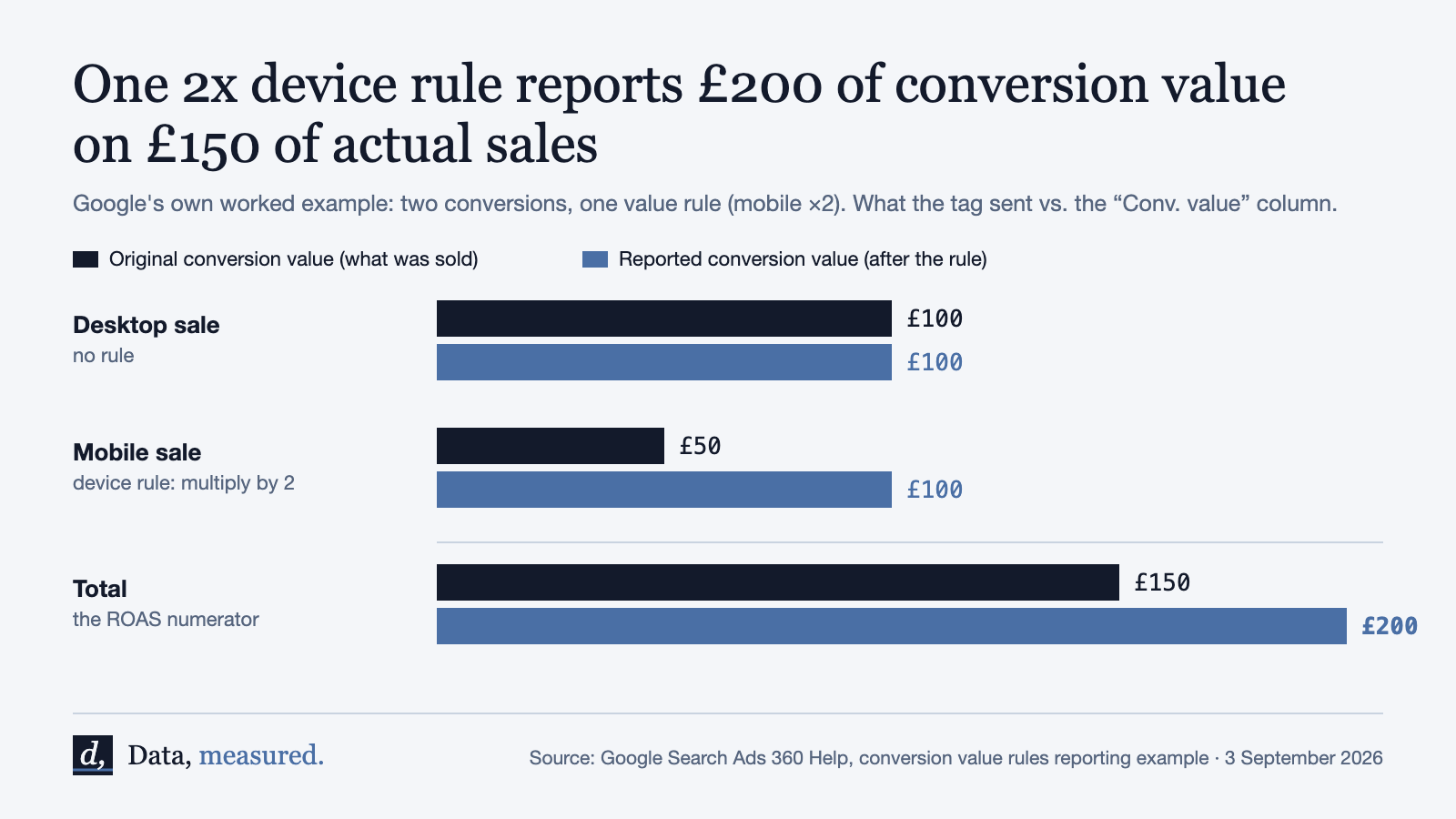
What changed on 19 August is auditability. API v25.1 exposes metrics.original_conversion_value, "the unadjusted value of conversions before any value rule adjustments", adds segments.loyalty_membership to slice metrics by "the loyalty program tier of the converting user", and records loyalty as a value-rule dimension so a report shows "when a loyalty membership condition was satisfied". The original value was a column you could look at. Now it is a field you can reconcile.
The compliance angle: every condition is a list of people
Audience conditions, loyalty tiers and the new-customer decision are matched against customer lists you uploaded; Merchant Center takes loyalty tiers as Customer Match lists, so a loyalty value rule is a bid multiplier keyed to a hashed email you provided. The Customer Match policy sets the terms: only information "collected in the first-party context", a privacy policy that discloses "that you share customer data with third parties to perform services on your behalf", and consent "where required by law or any applicable Google policies", which for EEA and UK users means the EU User Consent Policy. Log the upload date of every list a rule depends on, because the reported value changes the day the list lands. The rule itself needs no consent; the list it reads does, and the notice behind that list should say what it is used for. A bid multiplier is a use.
Where the margin should live
| Route | What it does to "Conv. value" | Cost to run | Where it breaks |
|---|---|---|---|
| Value rules in the platform | Rewrites it per audience, location, device or loyalty tier: 0.5x to 10x, or a flat add | Minutes; no tagging change | Finance reads the rewritten column; rules outlive whoever set them |
| Lifecycle goals (new customer value) | Adds a flat bonus to first purchases Google classifies as new | One setting plus your existing-customer lists | The bonus is reported as value; "new" depends on list freshness |
| True value in the tag (margin, not revenue) | The column equals what you would defend; nothing to strip | Server-side or backend margin per order | A shared margin hands unit economics to the platform |
| Warehouse reconciliation via the API | Keeps both columns and the gap as a daily metric | One API pull, one scheduled query | A day of latency; an engineer for the first week |
The house view: rules and goals are legitimate bidding tools; the defect is treating their output as a measurement.
The Expert Perspective
Practitioners saw the distortion before the column existed. Search Engine Land's April guide to lifecycle goals: "Google reports that added amount as in-platform conversion value, on top of the actual value from the sale or lead", and "for ROAS-based bidding, the additional value can artificially inflate your campaign's ROAS"; the "Conv. value / cost" figure "will still include the added value in its reporting". One specialist quoted by PPC Land called it "pretty much useless"; another noted that "for most accounts this will be the same as Conversion value". Both are right about their own accounts and wrong about the one you inherit, where three value rules and a new-customer bonus produce a ROAS nobody can decompose. PPC Land's read of v25.1 is the useful one: loyalty as a rule dimension makes "the rule's trigger auditable in reporting, which matters when a bidding strategy is optimising against values that no longer match transaction amounts". One limit remains: nothing in the API says why a conversion was classified as new.
Conclusion & Next Steps
The installable artefact is one reconciliation query and three rules. From the campaign resource, pull campaign.name, segments.conversion_value_rule_primary_dimension, metrics.conversions_value and metrics.original_conversion_value for the last 30 days, scheduled into the warehouse daily.
- Gap rule: reported minus original is the adjustment. Publish it beside ROAS and write down the share you will tolerate before a rule is reviewed.
- Two-ROAS rule: finance and board decks use original value; the bidding team uses adjusted value. Label both, never average them.
- Change-log rule: every value rule and lifecycle goal gets a creation date, an owner and the list it depends on, in the same log as your conversion-window changes (our GA4 windows issue has the template). A ROAS step on the date of a rule change is not performance.
FAQ
Do value rules change what I am charged?
Not directly. They change the value Smart Bidding optimises toward, so they change bids; cost is what the auction charges.
If I run no rules and no lifecycle goals, do the columns match?
Yes, and that is the one-line audit: if the two columns differ and you set no rule, someone did.
Does original conversion value appear in GA4 or the Ads transfer to BigQuery?
GA4 reports its own key-event values, not Google Ads' adjusted ones. For the warehouse, pull the metric through the Ads API; check your transfer's schema first.
References & Sources Cited
- Google Ads API: release notes, v25.1 (19 August 2026); conversion value rules.
- Google Ads Help: about value rules; set up value rules; value rules report; measure lifecycle goals; about lifecycle goals.
- Search Ads 360 Help, conversion value rules reporting.
- Merchant Center Help, merchant loyalty program; Customer Match; EU User Consent Policy.
- Search Engine Land: customer acquisition and retention goals (23 April 2026); a new conversion metric (18 November 2025); API v25.1 (August 2026).
- PPC Land: original conversion value metric (November 2025); API v25.1, allowlist only (August 2026).
Forwarded this by a friend? Subscribe here. Found it useful? Forward it to one person who'd want it.
See you soon,
Team Data Measured
Data Measured is researched and fact-checked by our Editorial Team. We explain measurement; nothing here is legal advice.