🗓️ Your September Search Data Has a Seam: The Two API Fields That Date the AI Max Migration, and Why the Cohorts Land Differently
Google is upgrading Search campaigns to AI Max all month, one campaign at a time. Two timestamp fields date each seam. The cohorts arrive differently.
🚀 THE EXECUTIVE SUMMARY
The Definition: On 1 September Google Ads began automatically upgrading Search campaigns still running campaign-level broad match or standalone automatically created assets to AI Max. The job "will roll out progressively throughout the month" and closes on 30 September. Two output-only fields record when each campaign flipped: campaign.aca_migration_date_time and campaign.broad_match_migration_date_time, each a timestamp "in the customer's timezone and in 'yyyy-MM-dd HH:mm:ss' format".
The Core Insight: This is a treatment applied on a different day for every campaign, at a different dose per cohort. Campaigns arriving from broad match land with text customization off. Campaigns arriving from automatically created assets land with it on. A September-against-August comparison at account level therefore measures the migration schedule, not the product. The unit of analysis is one campaign, before and after its own timestamp.
What moved, and on which day
The gate closed first. Since 3 August, creating new campaign-level broad match configurations or legacy automatically created assets has been "blocked across the UI, Google Ads Editor, and all versions of the API". API versions released after 1 September "will completely remove the legacy entities"; active versions keep editing them until sunset, "around September 2027". There is no opt-out.
The useful part is the pair of timestamps. Both are selectable, filterable and sortable, so the migration date can live in the warehouse as a dimension rather than as a memory. Google's own sample query carries a trap: it filters both fields at once with AND, so a campaign that only ever had automatically created assets, and never gets a broad match timestamp, drops out of the result. GAQL has no OR. The grammar is WhereClause → WHERE Condition (AND Condition)*. Run it twice, once per field, or select both fields with no WHERE clause and filter in your own code. The fields are output only: nobody restates them in October.
The cohorts do not arrive alike:
| Cohort | Search term matching | Text customization | Final URL expansion | Brand lists |
|---|---|---|---|---|
| Campaign-level broad match | On by default | Off | Off | Preserved in place |
| Standalone automatically created assets | On by default | On by default | Off | Preserved in place |
One flag separates them, and it is the flag that rewrites your ad copy.
The compliance angle: generated copy, and a disclaimer that fails quietly
Text customization "uses text from your existing ads, landing page copy, and assets along with generative AI ... to create customized ad copy". The automatically created assets cohort gets it switched on at migration. In the asset report those assets are marked "Google AI" in the "Added by" column. That is the audit trail: export it weekly.
Google's control for required wording is the text disclaimer asset: up to 90 characters, "guaranteed to appear in the description line section in your responsive search ads (RSA)", and "compatible with all AI Max features, including Final URL Expansion (FUE) and text customization (TC)". An approved disclaimer takes the first description slot, so where you pinned copy there, "assets in the description line 1 position will not serve". And the failure mode is silent: "If a disclaimer asset is disapproved during policy reviews, your responsive search ad will continue to serve", with other lines in its place. A required disclosure that can vanish without stopping delivery is a monitored object, not a setting.
Four routes through a mid-month seam
| Route | What it gives you | Cost to run | Where it breaks |
|---|---|---|---|
| September against August, account level | A number you cannot defend | Nothing | Each campaign migrated on its own day, and the cohorts differ |
| Annotate by hand in the interface | A note beside one chart | An hour, once | It never reaches the warehouse or the board deck |
| Pull both timestamps daily into the warehouse | Per-campaign before and after windows, plus a cohort flag | One scheduled query | Output-only fields: a month you failed to capture is gone |
| Geo-split the campaigns carrying budget | An incrementality read that survives the seam | Two to four weeks of split spend | It measures AI Max against AI Max, never against August |
The house view: the warehouse route is the only one still true in December, and the cheapest to start. Run the geo test afterwards, for the question timestamps cannot answer.
The Expert Perspective
Google's own headline number is carefully drawn. AI Max campaigns "see an average of 7% more conversions or conversion value at a similar CPA/ROAS when using the full feature suite ... compared to using search term matching alone". That is AI Max measured against AI Max. It says nothing about the campaign you ran in August.
Independent readings are less comfortable. Lunio's retail invalid traffic report covers 414 million ad clicks across 88 retail ad accounts, Q4 2025 to Q2 2026. AI Max campaigns started cleaner than standard Search, 2.46% invalid traffic against 3.72%, then "more than doubled to 5.28% (a 114% increase), while standard Search campaigns in the same accounts held broadly flat and ended the period 17% lower than they began".
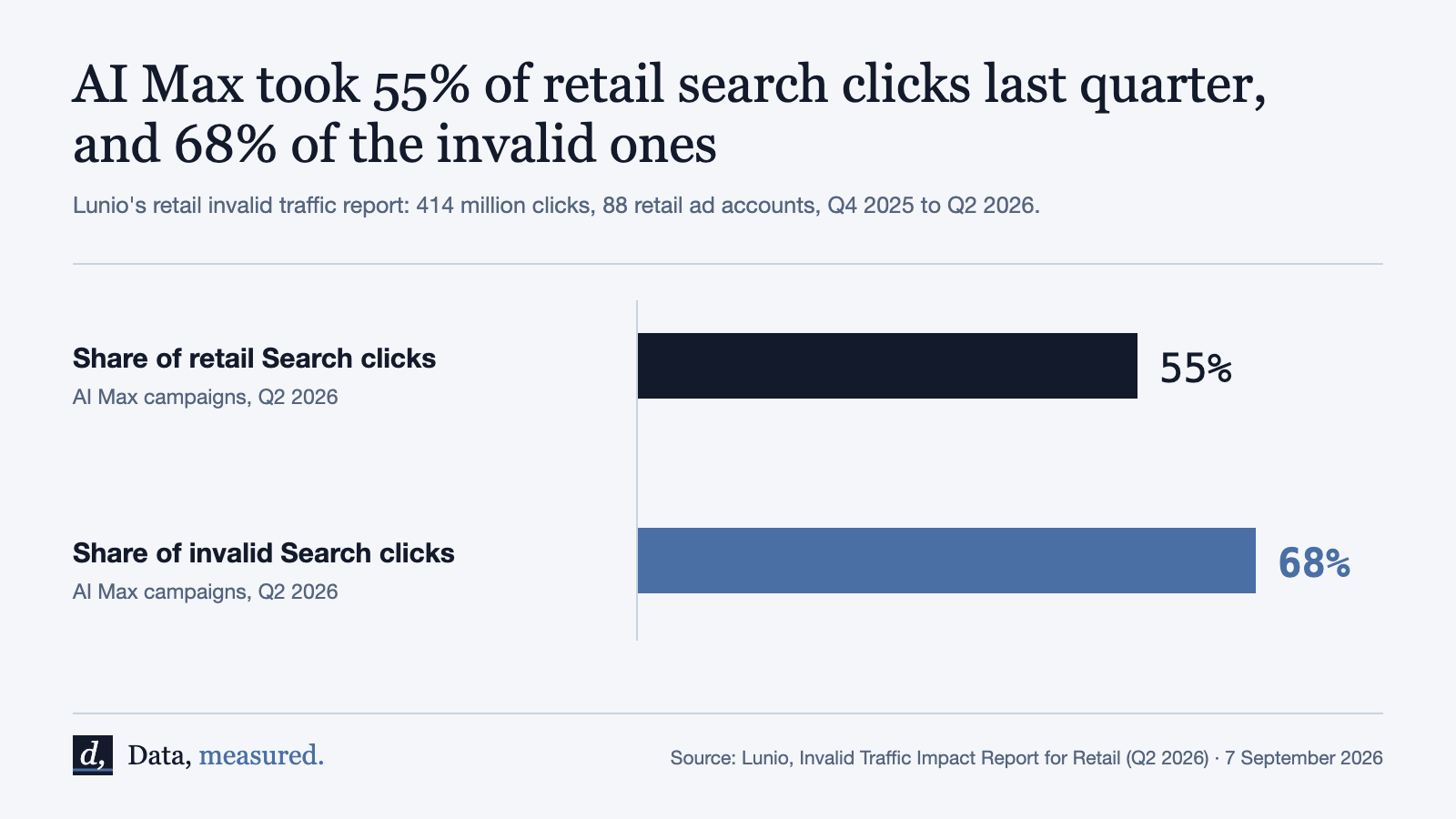
Lunio sells invalid traffic filtering, so read the framing with that in mind. The measurement point survives the conflict of interest. If the invalid share of clicks moves when the campaign type moves, the denominator under your cost per acquisition moved on migration day too, for reasons unrelated to your bidding.
Conclusion & Next Steps
- Pull both timestamps daily to 30 September, as two queries rather than one, into a campaign dimension table with a cohort label.
- Add
segments.search_term_match_sourceto the search terms pull soAI_MAX_KEYWORDLESSandAI_MAX_BROAD_MATCHstay separable from advertiser keywords. - Export the asset report weekly with the "Added by" column, and check every text disclaimer's approval status daily.
- Never report September as one period. Report each campaign against its own timestamp, and footnote the cohort it came from.
The migration is not the interesting event. What matters is that a platform change is, for once, dated by the platform itself, per campaign. That expires when the month does. Same argument as the seam left by GA4's custom conversion windows.
FAQ
Can we opt out or delay? No. Creation was blocked on 3 August and the September upgrade has no opt-out. Legacy Dynamic Search Ads are excluded and migrate between 1 and 28 February 2027.
Will our API integration break? Only if it writes. Versions released after 1 September drop the legacy entities; active versions keep them until sunset, around September 2027. Audit any script that still creates or edits those settings.
How do we tell which cohort a campaign is in? By which timestamp is populated. A campaign can carry both, which is why the two queries matter.
What changes in reporting? The search terms report gains an "AI Max" match type, a "Source" column and a combined view of terms and landing pages. The keywords report gains "Total: AI Max expanded matches" and "Total: AI Max landing page matches". The landing pages report gains "Selected by". In the API: segments.search_term_match_source, ai_max_search_term_ad_combination_view and expanded_landing_page_view.
References & Sources Cited
- Google Ads Developer Blog, the migration notice (12 August 2026).
- Google Ads API: campaign field reference; GAQL grammar; AI Max reporting.
- Google Ads Help: how AI Max works; reporting in AI Max; text disclaimers.
- Google blog, the DSA upgrade; Search Engine Land, the timeline; PPC Land, the creation block.
- Lunio, invalid traffic across 414 million retail clicks (August 2026).
Forwarded this by a friend? Subscribe here. Found it useful? Forward it to one person who'd want it.
See you soon,
Team Data Measured
Data Measured is researched and fact-checked by our Editorial Team. We explain measurement; nothing here is legal advice.