🚦 Server-Side Tagging Doesn't Read Your Consent Banner: What Actually Gates the Signal, With Configs You Can Copy
Move tags to your server and the banner stops blocking anything by itself. How consent really travels, what the law says, and the sGTM configs to copy.

🚀 THE EXECUTIVE SUMMARY
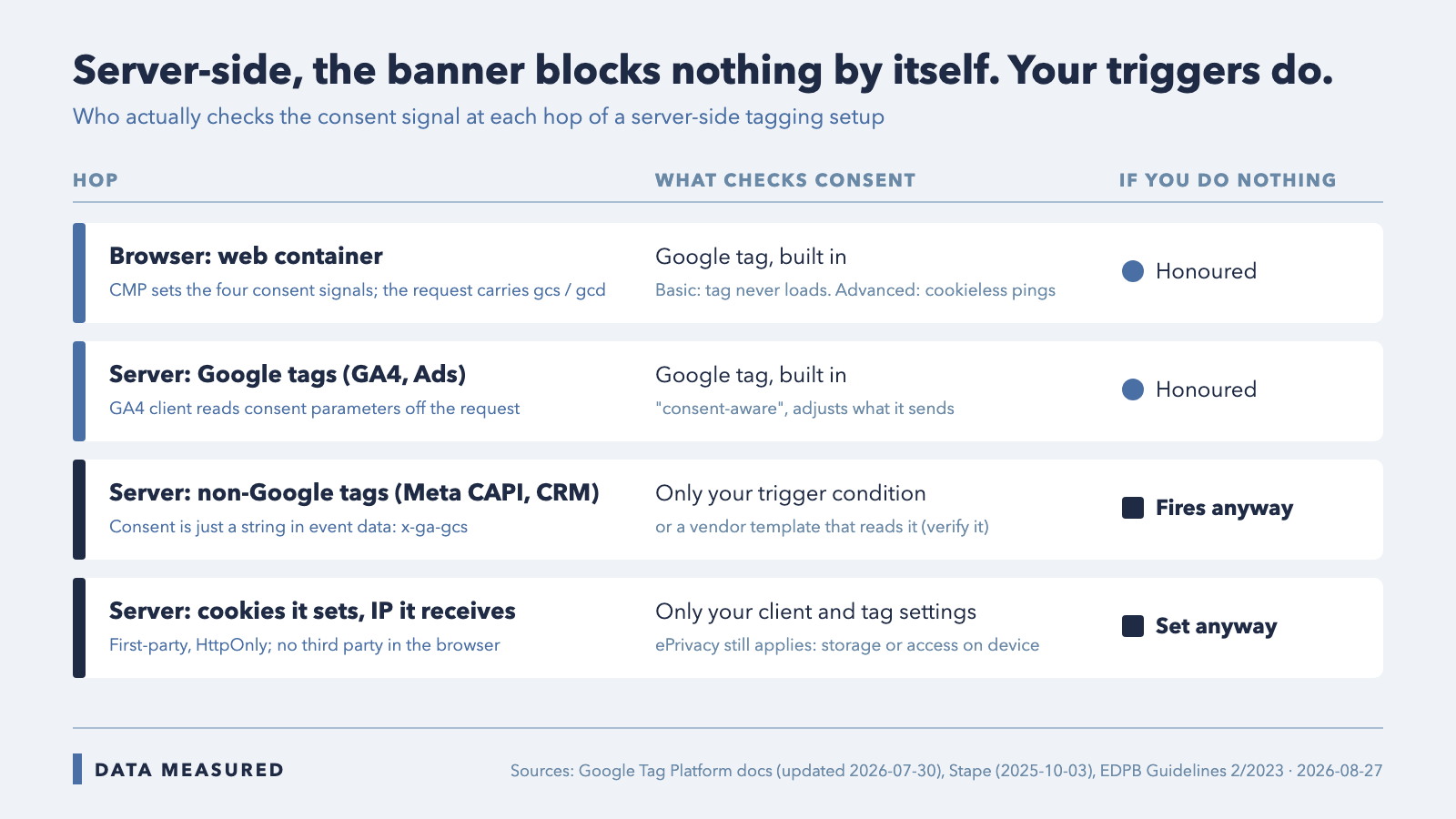
The Definition: In server-side tagging the consent banner never touches your server. The browser's Google tag copies the user's choices into two request parameters (gcs and gcd), the GA4 client reads them, Google's server tags honour them, and everything else sees consent as a string in event data.
The Core Insight: A banner "blocks" client-side tags because they load in the browser it controls. On your server there is nothing to block. Google tags check consent themselves; your Meta CAPI, CRM and warehouse tags fire on whatever trigger you wrote. If that trigger does not read the consent string, the banner is decoration. The law, meanwhile, follows the device, not the hop.
How consent actually travels to a server container
Google's implementation guide, updated 30 July 2026, is plain about the mechanics: "The Google tag sends the user's preferences to the server container by adding consent parameters to the HTTP request. Google product tags in the server are consent-aware and adjust the amount and kind of data they send based on the user's preferences." Its key point follows: "you only need to set up consent mode in the web container." True for Google tags; most setups misread it as "consent is set up once."
The parameters are documented by practitioners. gcs has the shape G1xy: x is ad_storage, y is analytics_storage, 1 granted and 0 denied. Consent Mode v2 added gcd, which encodes all four signals. On the server, the GA4 client surfaces the first as the event-data key x-ga-gcs, which is all a non-Google tag can know about consent unless you send more.
The compliance angle: moving the tag moves nothing in law
The privacy pitch rests on a real fact: the browser only talks to your domain. The regulators' answer is that the rule attaches to the device, not to who receives the data. The EDPB's Guidelines 2/2023 (version 2.0, October 2024) say Article 5(3) ePrivacy "does not exclusively apply to cookies, but also to similar technologies," and that storage and access "do not need to be performed by the same party"; on tracking by IP alone, it "could apply even though the instruction to make the IP available has been made by a different entity than the receiving one."
The UK position hardened this year. The ICO finalised its storage-and-access guidance on 29 April 2026: the rule "applies where fingerprinting stores information, or accesses information stored, on a device," and "where tracking pixels store information (or gain access to information stored) on a user's device, regulation 6 applies." An HttpOnly cookie your server sets is storage; a signature built from headers is access. And on the performance team's question: "Does advertising measurement require consent? Yes, but this forms part of the consent you obtain for online advertising purposes."
Then the case to pin above every tag manager. The Administrative Court of Hannover ruled on 19 March 2025 (10 A 5385/22) that "the use of the Google Tag Manager service requires consent" under § 25(1) of Germany's telecom-privacy act and Article 6(1)(a) GDPR. The authority's lab test found that on first load, before any banner interaction, the site contacted googletagmanager.com and transmitted an ID plus the device's IP address, configuration, country and referrer URL. The court counted transmitting device data before consent as the violation; a first-party proxy transmits the same data to the same places one hop later.
Block in the browser, gate on the server, or buy the check
| Approach | Where the check lives | Strength | What breaks |
|---|---|---|---|
| Block at the browser | Web container triggers | Nothing unconsented reaches the server; easiest to audit | Cookieless pings and redispatched events still arrive |
Gate at the server (your trigger reads x-ga-gcs) | Server triggers, per tag | One rule for every non-Google tag; loggable | Stape's warning: GA does not resend an updated gcs if consent changes mid-page |
| Buy the check (vendor templates) | Inside the template code | Zero configuration; Stape says its tags "automatically change tags' behavior based on the consent state" | You trust a template's reading of a string; an update can change it |
The house view: do the first two together; treat the third as a convenience you verify in preview, not a control. Gating on the server also yields the artefact regulators ask for: a per-event record of the consent string when the tag fired.
The Expert Perspective
Consent enforcement in a server container is not a feature, it is a convention, and conventions are only as good as the last person who edited the container. Every non-Google tag needs the same firing condition and blocking exception, including the one an agency adds next quarter.
Google is narrowing its controls to consent mode, which raises the cost of a wrong signal: from 15 June 2026 Analytics uses consent mode as the single control for Google Ads cookies and ID collection, with ad_personalization becoming the exclusive personalisation control later in 2026. The banner's four signals are now the only lever.
And "first-party" describes a domain, not a legal basis. If you would not set an identifier client-side without consent, do not set it server-side without consent.
Conclusion & Next Steps
The configs, as promised, for a standard web container with consent mode and a server container with the GA4 client:
- Variable: Event Data, key path
x-ga-gcs, namedED - gcs. - Firing trigger, ads destinations (Meta CAPI, TikTok, LinkedIn): Client Name equals
GA4, Event Name equals the forwarded event,ED - gcsmatches RegEx^G11.$. - Firing trigger, analytics-class tags (warehouse loaders, product analytics): same, with
^G1.1$. - Blocking exception on every non-Google tag:
ED - gcsdoes not match the RegEx above; it catches a tag later attached to the wrong trigger. - The two v2 signals:
x-ga-gcscarries only the original pair. Forwardad_user_dataandad_personalizationexplicitly (a data tag adding aconsent_stateobject, or your own event parameters) and gate audience-building tags on them. - Server-set cookies: keep them off until the gates are verified in preview, then put them behind the same condition.
- Proof: write
ED - gcsas a column in whatever the server loads into your warehouse.
Then run the Hannover test: open the site cold, decline everything, and watch what your server sends outbound. Background reading: our April issue on the untreated setup and the GTM vs server-side GTM comparison.
FAQ
Does server-side tagging remove the need for a cookie banner?
No. The rule attaches to storing or accessing information on the device, and the EDPB says it covers "similar technologies," not only cookies. Server-side tagging changes who the browser talks to, not what is stored or read.
Do Meta CAPI tags in server GTM respect Google consent mode automatically?
Not by themselves. A non-Google tag knows only what its trigger checks. Some vendor templates read consent state; verify in preview and add your own condition regardless.
Is advertising measurement exempt from consent?
No. Under the ICO's guidance it needs no separate consent because it is part of the advertising purpose, but a declined banner declines the measurement too.
References & Sources Cited
- Google Tag Platform, Implement consent mode with server-side Tag Manager (updated 30 July 2026).
- Google Analytics Help, Updates to Google Analytics Data Controls.
- Simo Ahava, Consent Mode V2 For Google Tags (2024) and Automatic Page View Hits In SGTM After Consent Granted (2024).
- Stape, Consent mode in server Google Tag Manager (3 October 2025).
- EDPB, Guidelines 2/2023 on Technical Scope of Art. 5(3) of ePrivacy Directive, v2.0 (7 October 2024).
- ICO, Guidance on the use of storage and access technologies (finalised 29 April 2026): technologies, online advertising.
- VG Hannover, 19 March 2025, 10 A 5385/22, full text on NI-VORIS (German); summary by TCI Rechtsanwälte.
Forwarded this by a friend? Subscribe here. Found it useful? Forward it to one person who'd want it.
See you soon,
Team Data Measured
Data Measured is researched and fact-checked by our Editorial Team. We explain measurement; nothing here is legal advice.